 English
 Français


Decimals of EUR must be at least 3. Please update the Number of Decimals.
37 guests are viewing this product
Fundamentalising « the Other » as Fundamentalist
4,000 €
AUTEUR : CLAUDIA JAHNEL
ABSTRACT
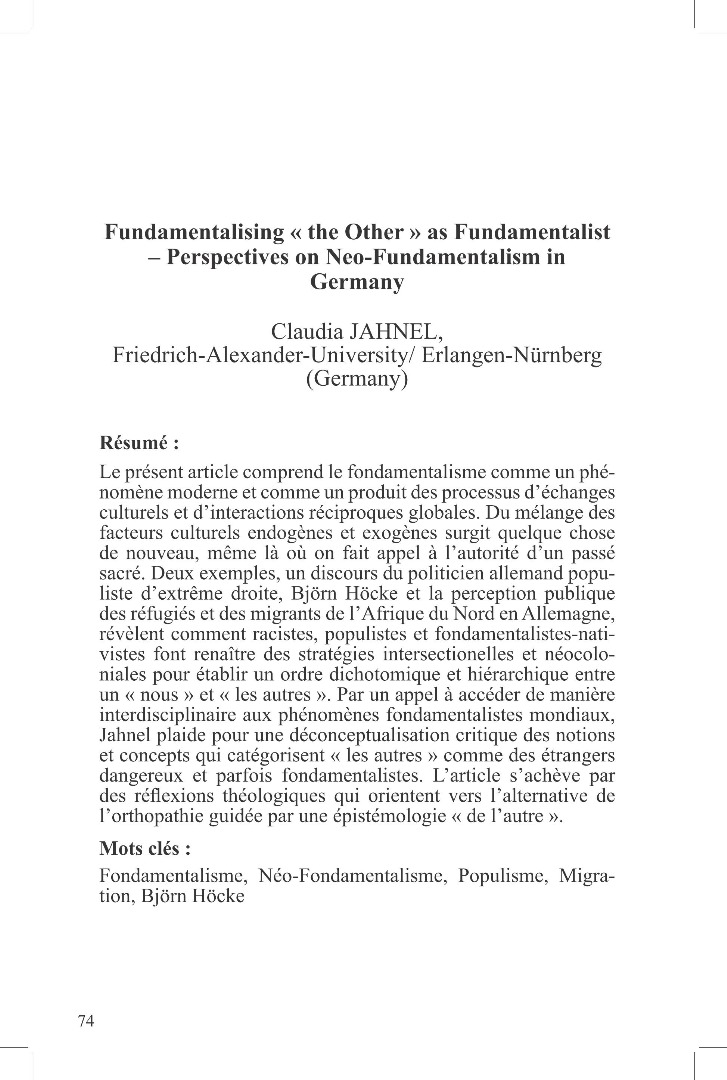
The current article understands fundamentlism as a modern phenomenon and as a product of cultural exchange processes as well as a product of reciprocal global interactions. Something new arises from the mixture of endogen and exogen cultural factors, even where one appeals to the authority of a sacred past. Two examples, namely the discourse of the german populist politician, Björn Höcke, and the public perception of refugees and migrants from north Africa in Germany reveals how racists, populists and fundamentalist-nativitists give a new birth to intersectional and neocolonial strategies in order to establish an dichotomical and hierarchical order between « we » and « the others ». With an appeal to access the global fundamentalist phenomena, Jahnel pleads for a critical deconceptualisation of notions and concepts which categorise « the others » as dangerous strangers and sometimes as fundamentalists. The article ends with theological reflections which lead towards the alternative of an orthopathy which is guided by an epistemology « of the other ».
The current article understands fundamentlism as a modern phenomenon and as a product of cultural exchange processes as well as a product of reciprocal global interactions. Something new arises from the mixture of endogen and exogen cultural factors, even where one appeals to the authority of a sacred past. Two examples, namely the discourse of the german populist politician, Björn Höcke, and the public perception of refugees and migrants from north Africa in Germany reveals how racists, populists and fundamentalist-nativitists give a new birth to intersectional and neocolonial strategies in order to establish an dichotomical and hierarchical order between « we » and « the others ». With an appeal to access the global fundamentalist phenomena, Jahnel pleads for a critical deconceptualisation of notions and concepts which categorise « the others » as dangerous strangers and sometimes as fundamentalists. The article ends with theological reflections which lead towards the alternative of an orthopathy which is guided by an epistemology « of the other ».
| Authors | Claudia Jahnel |
|---|---|
| Themes | interreligious dialogue |


Reviews
There are no reviews yet.